Is Elon Boring the Future?
How an Underground Delivery Grid Could Relieve Our Cities
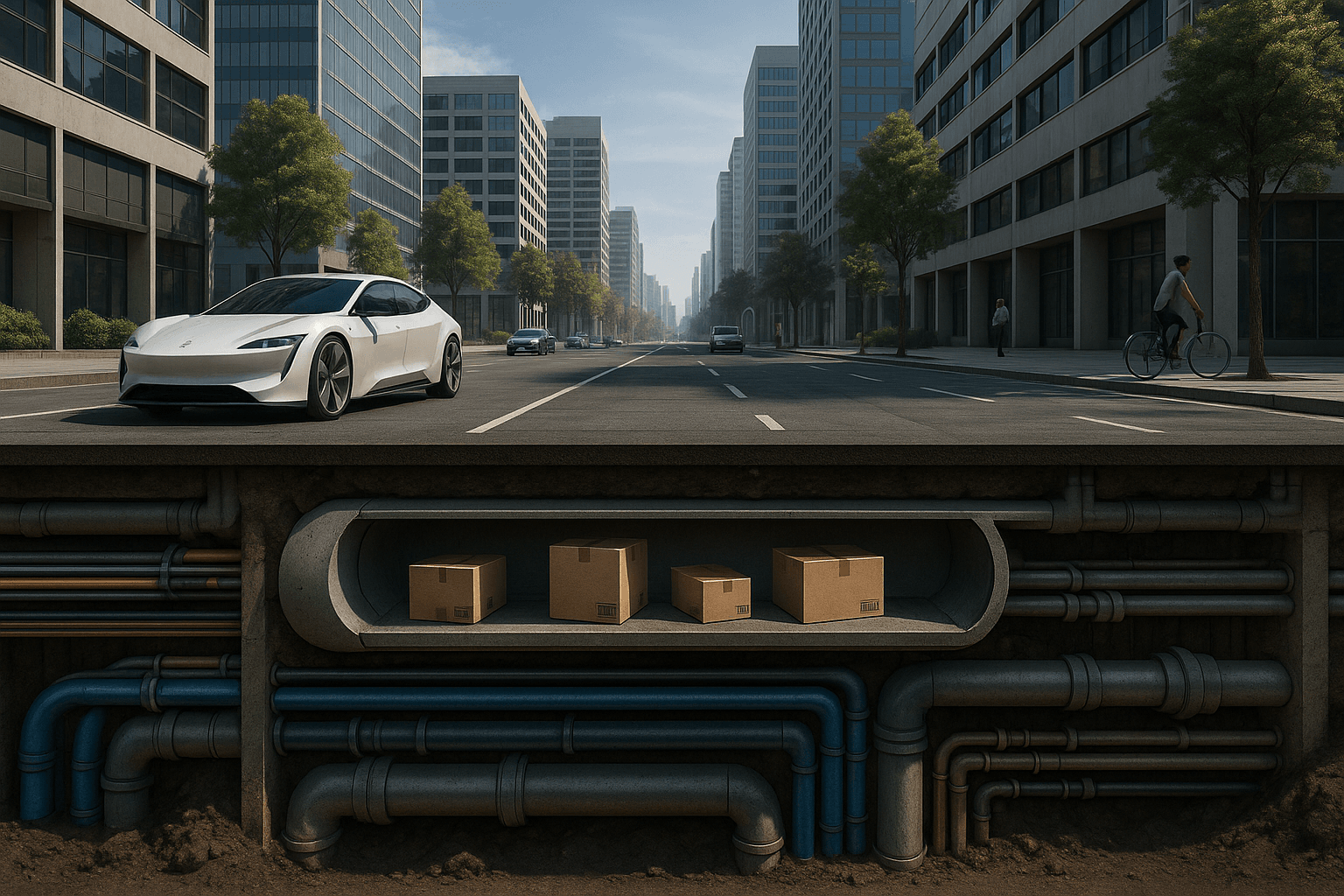
Elon Musk started a company in California called The Boring Company. At its launch, it was selling flamethrowers, but its main objective was to build tunnels for Teslas to zoom through Los Angeles traffic. The premise was simple: the ground we live on is super congested and to solve the problem, the focus is to go airborne or underground.
But how did we increase congestion in the last 10 years or so? Home and office deliveries. Yes, the average household these days receives at least five deliveries per week in most countries. These are delivered through bikes, cars, and trucks – all adding to our on-ground congestion.
It’s like the added traffic and waiting times caused when smoking was banned inside offices. Suddenly, elevator lines grew longer because everyone had to head downstairs to smoke. We changed our habits, but we continuously and daily add to our congestion problems to the point where traffic is reaching unlivable levels in some cities.
From Amazon to Uber Eats, eCommerce and quick commerce have overwhelmed the very cities they promised to simplify. And that pressure is only going to grow. Every app, every buy now button, every on-demand service adds a logistical layer we haven’t properly planned for because we’ve optimized for speed, not space. We’ve scaled our consumption (full disclosure: I’m part of the problem), but not the infrastructure behind it – or beneath it…
Because what if the solution wasn’t above ground at all? In fact, the solution exists, and Elon might have already started this train of thought. Boring, again.
We once thought plumbing a city for clean water was unimaginable. Same for electricity. Same for sewage. Today, we don’t think twice about flipping a switch or flushing a toilet. Even the internet – once the stuff of science fiction – is now wired into every home. We’ve basically laid networks beneath our feet to power life above them. So why not do the same for deliveries?
Here’s the proposal. Let’s stop jamming today’s habits into yesterday’s streets. Let’s introduce a new infrastructural layer – boring a network for deliveries. Just as we once laid pipes for water and cables for power, it’s time we carve a new channel: a sealed, smart, and subterranean delivery grid built not for people, but for packages and parcels.
Picture a system where your groceries or goods don’t fight traffic. They flow quietly through a dedicated underground network, emerging directly into a smart locker or built-in delivery chute in your kitchen. No congestion. No noise. No emissions. Just movement, reimagined.
If that sounds far-fetched, so did toilets in the 1800s. Sewage systems were once dismissed as impractical. Electricity grids were considered too volatile. Even indoor plumbing was a leap. Eventually though, we understood: modern life doesn’t evolve without systems.
And here's the twist: we might not even need to build an entirely new network. The infrastructure already exists under us. What’s missing is the imagination to rethink its purpose. What if we used the sewer network itself – safely, hygienically, intelligently – to move parcels? Boxes sealed and routed through modified sewer lines. We get squeamish now, but culture catches up. It always does.
We’re sold a sci-fi version of urban innovation: flying taxis, robot roommates, vertical forests. But the real breakthroughs often happen in the simplest of ways: in the pipes, the grids, the networks that shape how we live. Because a delivery pipe won’t just fix logistics. It will give cities back their streets, their sidewalks, the space where there is none.
So Elon, if you're reading – this might be the next venture for The Boring Company.